
NEWS
May 27, 2026
IN BRIEF
Every new kidnapping, violent attack, or unresolved case deepens a difficult question many Nigerians are asking: who exactly feels protected by the country’s policing system? Across Nigeria, insecurity continues to rise while public trust in law enforcement institutions continues to weaken. For many citizens, the policing crisis is no longer only about crime. It is increasingly about accountability, legitimacy, and whether security institutions still command public confidence. It was against this backdrop that the Open Alliance convened a stakeholder dialogue [...]
SHARE
Every new kidnapping, violent attack, or unresolved case deepens a difficult question many Nigerians are asking: who exactly feels protected by the country’s policing system?
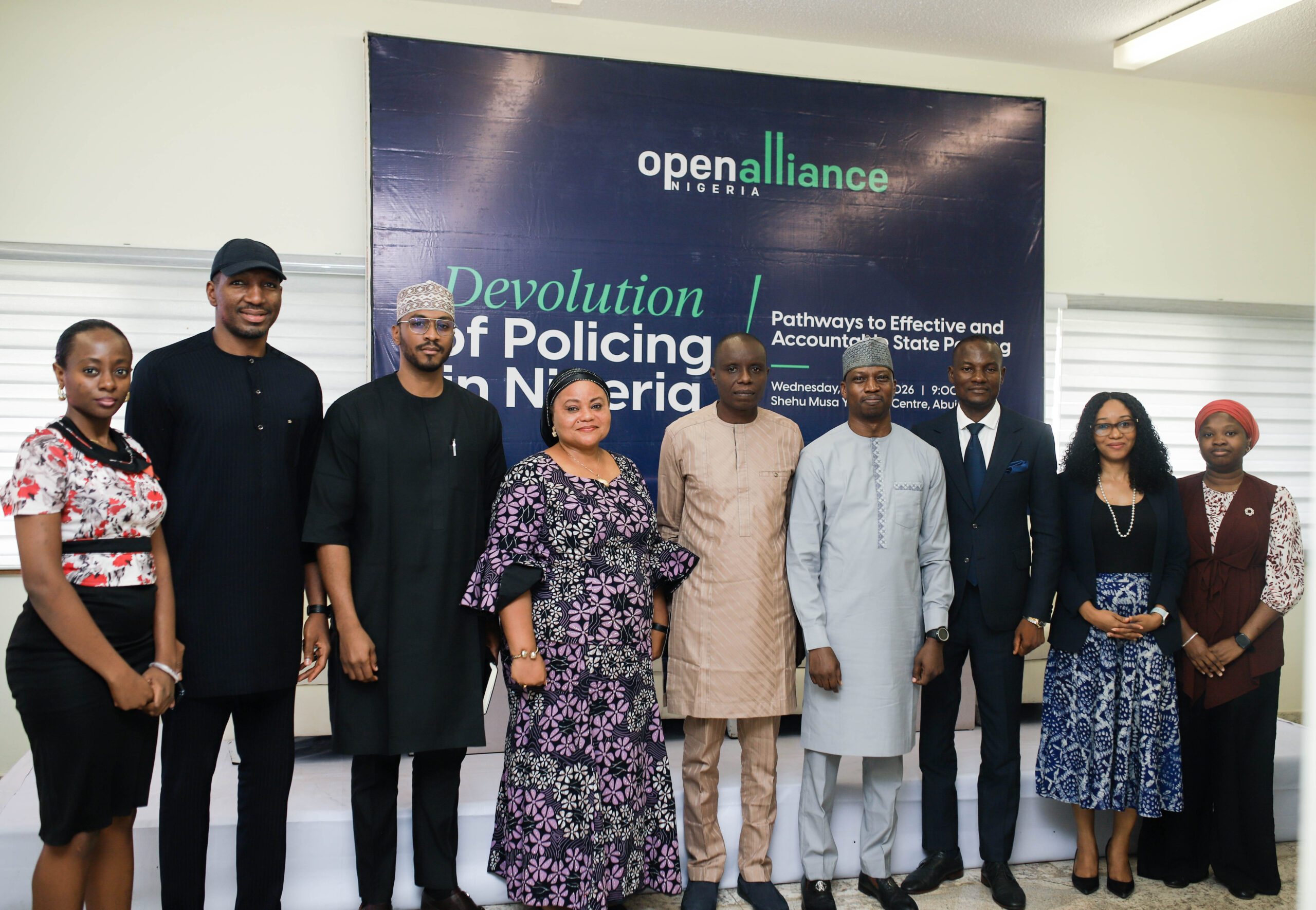
Across Nigeria, insecurity continues to rise while public trust in law enforcement institutions continues to weaken. For many citizens, the policing crisis is no longer only about crime. It is increasingly about accountability, legitimacy, and whether security institutions still command public confidence. It was against this backdrop that the Open Alliance convened a stakeholder dialogue in Abuja on “Devolution of Policing in Nigeria: Pathways to Effective and Accountable State Policing.”
The dialogue brought together representatives from civil society organisations, governance institutions, development partners, legal practitioners, security experts, media professionals, and policy actors to deliberate on the opportunities, risks, and governance implications surrounding state policing in Nigeria.
Opening remarks were delivered by Mr. Friday Odeh of Accountability Lab Nigeria. He noted that rising insecurity, weak public trust in institutions, lack of transparency, and recurring reports of human rights violations reflect a broader accountability crisis in Nigeria. He emphasised that conversations around state policing should not focus solely on control of policing structures but on building policing systems that are transparent, accountable, rights-based, and trusted by citizens.
Remarks delivered on behalf of the Executive Director of Paradigm Leadership Support Initiative (PLSI), emphasis was placed on the need for accountability, transparency, evidence-based advocacy, civilian oversight mechanisms, and community engagement in any proposed state policing framework. The remarks highlighted the responsibility of civil society organisations to support policy reforms, citizen education, and continuous monitoring of accountability mechanisms within the security sector.
The dialogue also featured a keynote presentation delivered by Mr. Tosin Osasona, which examined broader issues surrounding policing reforms, institutional accountability, operational effectiveness, and public trust in Nigeria’s security architecture. The presentation highlighted the central role of the Nigerian police as one of the most visible institutions of the Nigerian state and a critical instrument of public security and social control. It was noted that the Force remains the largest security agency in Nigeria, with approximately 370,000 officers and over 6,000 police stations, police posts, and village police posts nationwide.
Key Issues Highlighted During the Dialogue:
- Institutional and Governance Concerns: Participants noted that the Nigerian Police Force remains one of the most visible institutions of the Nigerian state and plays a central role in maintaining law and order. However, concerns were raised regarding chronic underfunding, operational inefficiencies, weak accountability systems, legitimacy deficits, and declining public trust in policing institutions.
- State Policing and Decentralisation: Participants acknowledged that proponents of state policing argue that decentralisation could improve local intelligence gathering, strengthen community ownership, enhance responsiveness to security threats, and improve policing effectiveness.
The dialogue recognised the varying fiscal and institutional capacities of states and emphasised that any move toward state policing should adopt a phased and conditional implementation approach based on governance performance, accountability systems, and financial sustainability.
Fiscal Sustainability and Institutional Capacity: Discussions highlighted the importance of strengthening Internally Generated Revenue (IGR), reducing dependence on volatile federal allocations, improving fiscal transparency, and ensuring effective management of wage obligations as important considerations for any state policing framework.
Participants repeatedly stressed that the state police debate cannot simply become a conversation about who controls armed institutions. The deeper issue is whether Nigeria can build policing systems that citizens actually trust. Questions around transparency, human rights protections, civilian oversight, operational accountability, and public legitimacy dominated the conversations as much as security itself.
Reform Pathways
The dialogue explored possible reform pathways for decentralised policing, including phased or opt-in implementation models where states qualify based on clearly defined fiscal and governance benchmarks.
Stakeholders also discussed hybrid and regional policing arrangements as possible alternatives for states with lower fiscal capacity, encouraging inter-state collaboration, resource sharing, and coordinated policing systems supported through federal partnerships.
Major Policy Debates
The dialogue highlighted several major debates shaping ongoing conversations around policing reforms in Nigeria, including:
- Structural reform versus cosmetic reform
- Centralised policing versus state policing
- Legitimacy-first reform versus security-first reform
- Militarised policing versus rights-based policing approaches
Questions and Stakeholder Contributions
During the plenary session, participants raised concerns regarding police accountability, operational standards, police welfare, funding structures, and the relationship between federal and state policing systems.
Questions were also raised about the overlap of functions among existing security institutions, the independence of policing structures, the use of technology and intelligence systems, and the need to ensure that policing reforms reflect Nigeria’s diverse social and cultural realities while remaining consistent with constitutional rights and the rule of law.
Contributors emphasised that while operational flexibility may reflect local realities, minimum national standards on professionalism, human rights protections, accountability, and constitutional safeguards must remain uniform across all states.
Stakeholders further stressed the importance of nationwide sensitisation, grassroots consultations, and inclusive citizen engagement to ensure that communities across the six geopolitical zones are adequately represented in ongoing conversations around state policing reforms.
Recommendations
The participants at the event recommended the following:
- Establish clear constitutional and legal safeguards to prevent political interference and abuse of policing powers at the state level.
- Adopt a phased and conditional approach to state policing based on fiscal sustainability, governance performance, institutional capacity, and accountability benchmarks.
- Develop and enforce minimum national standards for police training, professionalism, operational conduct, and human rights compliance across all states.
- Strengthen civilian oversight systems, independent accountability mechanisms, and citizen complaint channels to improve public trust in policing institutions.
- Improve police welfare, remuneration, operational funding, equipment, and continuous capacity development to enhance professionalism and effectiveness.
- Promote nationwide sensitisation, grassroots consultations, and citizen engagement to ensure that communities across Nigeria are actively involved in shaping policing reforms.
- Explore regional and hybrid policing models for states with limited fiscal or institutional capacity to sustain their own policing structures.
Conclusion
The event concluded with a collective recognition that policing reforms in Nigeria must be transparent, accountable, rights-based, and citizen-centred. Participants emphasised that any transition toward state policing must be carefully designed through inclusive consultations, evidence-based reforms, phased implementation approaches, and robust institutional safeguards.
Stakeholders reaffirmed the important role of civil society organisations, governance institutions, development partners, the media, and citizens in shaping effective and accountable policing reforms in Nigeria.
Signed:
- 21st Century Community Empowerment for Youth & Women Initiative
- Accountability Lab Nigeria
- African Centre for Entrepreneurship
- African Centre for Governance, Asset recovery & sustainable development
- BudgIT Foundation
- CDD West Africa
- Centre for Accountability & Inclusive Development
- Centre for Inclusive Social Development
- Centre for Transparency Advocacy
- CISLAC
- CLEEN Foundation
- Connected Development (CODE)
- Dataphyte Foundation
- FENRAD
- Global Agent for Emancipation
- Global Relief Empowerment Initiative
- Impact Driven Young Leaders Initiative
- Impact House Centre for Development & Communication Accelerating social impact initiative
- Inclusive Friends Association
- International Peace & Civic Responsibility Center
- Neighbourhood Environment Watch Foundation
- Nigeria Women Agro Allied
- OGP Nigeria
- PLSI
- Public and Private Development Centre (PPDC)
- Resource Centre for Human Rights & Civic Education (CHRICED)
- Shehu Musa Yar’Adua Foundation
- Socio-Economic Research and Development Centre (SERDEC)
- Volume pod